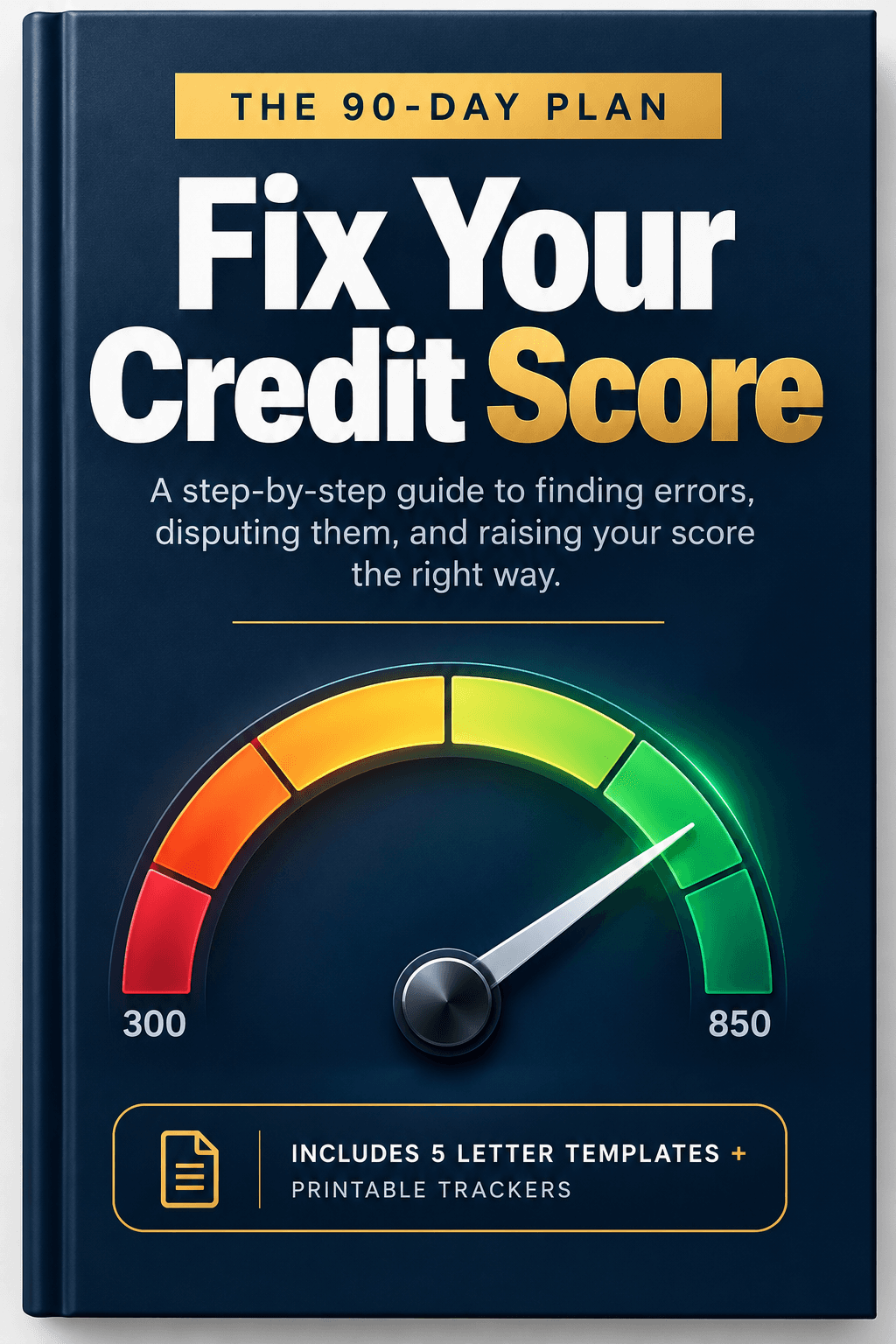
A 28-page U.S. credit guide with a week-by-week plan, five letter templates and printable trackers. Learn to check reports, dispute real errors and manage credit habits without promises of a particular score.
Format
PDF
Length
28 pages
Reading time
About 1 hour, plus the exercises
£9.99 GBPOne payment. Yours for life.
U.S.-specific, September 2026 edition. Includes five sample letters and three printable trackers inside the PDF. The 90 days are an action plan, not a guaranteed score increase or a credit-repair service. Credit rules and scoring models vary; this is general education, not personal financial or legal advice.
Secure checkout by Stripe. Your download is delivered by email.
Instant download
Secure payment
Lifetime access
PDF format
START WITH THE ESSENTIALS
How do you start improving your U.S. credit score?
Start with your credit reports: check all three for information that is wrong or incomplete. Document and dispute genuine errors, then review payment dates and card balances. Keep records of what you do and monitor changes over time. The 90-day plan in this book gives those steps a schedule, but no score increase is guaranteed.
Use the authorized AnnualCreditReport.com service to request U.S. reports from Equifax, Experian and TransUnion. Read each report for accounts, balances and personal details that may need investigation. A credit report and a credit score are different products.
Dispute actual errors with evidence
Explain what is wrong to the credit reporting company and the company that supplied the information. Include copies of relevant evidence and keep a record of the dates and responses. The book has two dispute letter templates and a log to help organize this work.
Review payments and card balances
Payment history and how close card balances are to credit limits can affect scores. The guide includes a utilization worksheet and a checklist for setting payment reminders or autopay where appropriate. Avoid assuming one target percentage or timetable will work for everyone.
Track progress without a score promise
Follow the weekly checklist, note which scoring model you are viewing and watch for corrected information. Accurate negative items may take longer to recover from; if you face a lawsuit, identity theft or another serious problem, seek qualified help.
This is a 28-page U.S.-specific educational guide, not a credit-repair service or personalized legal or financial advice. The 90-day period describes the checklist, not a guaranteed score improvement. It includes five adaptable sample letters and three trackers inside the PDF. Check current rules and your own circumstances with official sources.
A CLEARER WAY FORWARD
Learn how to check, dispute and rebuild U.S. credit
Understand your U.S. credit reports and build a practical 90-day action plan
Where to get your U.S. credit reports and how to compare information from Equifax, Experian and TransUnion
How to identify and document genuine errors before disputing them with a credit bureau and the company that supplied the information
How payment history and credit card utilization can affect scores, and how to plan around due dates and statement dates
What to consider before responding to collections, medical bills and student-loan problems
How secured cards, credit-builder loans and credit freezes fit into a longer-term plan
How to use the week-by-week checklist, five sample letters and printable score, dispute and utilization trackers
BETWEEN THE COVERS
Every chapter. A step forward.
8 chapters to explore. Open a chapter below to see what it covers.
01
How your credit score works
+
An introduction to U.S. credit bureaus, FICO and VantageScore, and why the score a lender uses may differ from the one in an app.
02
Get and read your credit reports
+
A checklist for comparing the three reports and spotting unfamiliar accounts, incorrect balances and other possible errors.
03
Dispute inaccurate information
+
How to organize evidence, contact the reporting company and the information provider, and track their responses.
04
Manage utilization and payment history
+
Worked utilization examples, payment reminders, statement dates and approaches to paying down card balances.
05
Collections and rebuilding
+
Questions to ask about debts, medical bills and student loans, plus introductory options for people with a thin credit file.
06
Protect yourself from fraud and false promises
+
Credit freezes, loan-shopping considerations and warning signs of credit-repair scams.
07
The 90-day checklist
+
A week-by-week sequence for reviewing reports, recording disputes, setting payment safeguards and monitoring changes.
08
Letters and printable trackers
+
Five sample letters, including bureau and furnisher disputes, plus a score tracker, dispute log and utilization worksheet. Adapt every letter to the facts of your own case.
FIND YOURSELF HERE
Written with you in mind.
People in the United States who want to understand and check their credit reports
Readers who have found a possible reporting error and want a documented way to dispute it
People rebuilding credit who want a structured set of habits and tracking sheets
Anyone comparing credit-repair claims with steps they may be able to take themselves
Start by checking your U.S. credit reports for mistakes and reviewing your current payment and card-balance habits. Dispute information that is genuinely inaccurate, pay obligations on time where possible and avoid taking on debt solely to chase a score. The book organizes these tasks into a 90-day checklist, but results vary.
Can this guide fix my credit score in 90 days?+
No guide can promise a score increase or a particular result by a deadline. Ninety days is the length of the action plan. Some report corrections or balance changes may appear sooner, while recovery from accurate negative information can take much longer.
Does the book explain how to dispute credit report errors?+
Yes. It covers checking all three reports, collecting supporting evidence, contacting the credit reporting company and the information provider, and logging the response. Sample letters are included. Dispute only information you believe is inaccurate or incomplete.
Does it apply to credit scores in the UK or other countries?+
No. The guide is written for the United States. Its bureaus, laws, letter templates, dollar examples and official resources are U.S.-specific. Credit reporting systems differ elsewhere.
What comes with the PDF download?+
You receive the 28-page PDF. It contains the nine chapters, a week-by-week plan, five sample letters, three printable trackers and a glossary. It does not include a credit-repair service, personal advice or a separate software tool.
Can accurate negative information be removed?+
The dispute process is for inaccurate or incomplete information; accurate negative information generally cannot be removed simply because it hurts a score. The guide discusses collections and optional goodwill requests without promising that any creditor or collector will agree.
Use a product screenshot to research suppliers on Alibaba and 1688, then compare samples, freight quotes and landed costs before buying. This 74-page guide covers importing into the UK, USA and Nigeria.
Learn how to create and sell PDF ebooks online with AI. A 25-page guide to product research, pricing, marketing and automated delivery, with prompts and checklists.
An 18-page practical companion for people prescribed GLP-1 medication for weight management. Includes a 7-day sample meal plan, protein cheat sheet, beginner strength routine and printable trackers.