
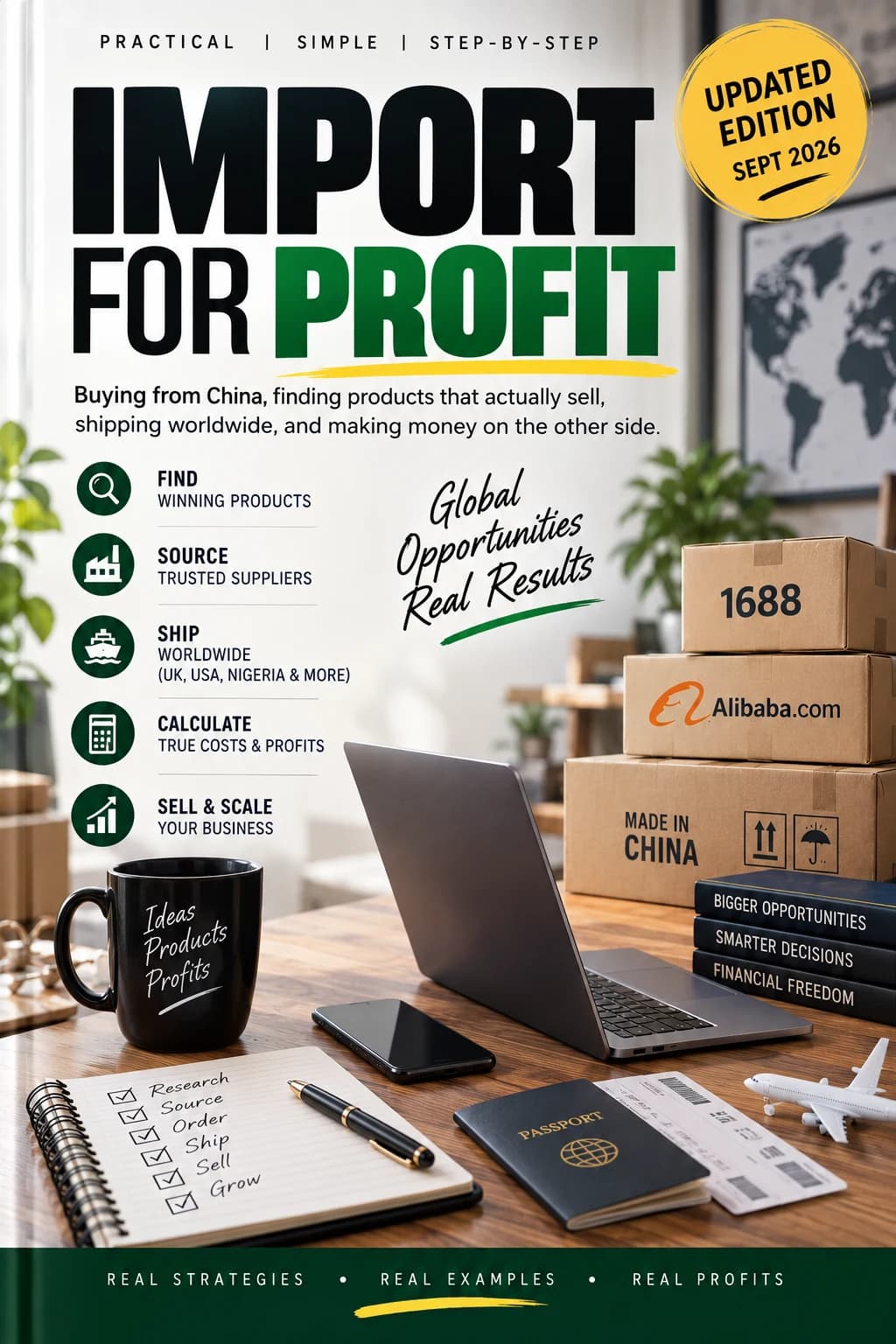
Import for Profit
A working method for finding a product, sourcing it, landing it, and checking honestly whether it makes money
Use a product screenshot to research suppliers on Alibaba and 1688, then compare samples, freight quotes and landed costs before buying. This 74-page guide covers importing into the UK, USA and Nigeria.
74 pages · PDF edition · About 2 hours
Updated [date pending confirmation] · Instant PDF download
Secure checkout by Stripe · Download link by email
Inside the PDF
What’s inside
Buying from China, finding products that actually sell, shipping them worldwide, and making money on the other side
- Why attention is not demand, and the six tests a product must pass before it earns your money
- The screenshot-to-supplier method: search Alibaba and 1688 by image, refine the terms and build a supplier shortlist to verify
- Why you search twice — once by image, then again using the supplier's own vocabulary in English and Chinese
- Why the same photograph on fifteen listings is often fifteen different products, and how to defend against it
- How to build a true landed cost, from the factory gate to your warehouse, and why the factory price is never the cost
- What duty, import VAT and product compliance actually involve in the UK, the USA and Nigeria
- How to model good, realistic and stress cases, and size a reorder without running out of cash
- How to prepare seller-account documents, compare marketplace and own-store routes, and plan verification before your stock arrives
01
What a winning product actually is
Why viral and profitable are different things, the trap of the single signal, and the categories worth avoiding while you learn.
02
Where to hunt
The research surfaces worth checking daily, ranked by how much they deserve your trust, and why you keep a list rather than a memory.
03
The screenshot to supplier method
The core of the book. Ten steps from a cropped screenshot to a supplier shortlist using Alibaba and 1688 image searches, including the intellectual property rule.
04
Sourcing in China
Where to find suppliers, the structured first message, verifying who you are really dealing with, samples and inspection.
05
Freight forwarders
What a forwarder actually does, how to get three genuinely comparable quotes, and the red flags that should end a conversation.
06
Choosing a shipping method
Courier, air freight, LCL and FCL compared, and why light bulky goods get billed on volume rather than weight.
07
Bringing goods into the UK
EORI, commodity codes, duty and import VAT, postponed VAT accounting, and the product controls that apply whatever your order size.
08
Bringing goods into the USA
HTS classification, the additional measures on Chinese-origin goods, and the Importer of Record trap that catches non-US sellers.
09
Bringing goods into Nigeria
Pro forma invoice, Form M, SONCAP and PAAR, and why the sequence matters more than any single document.
10
Landed cost and real profit
The arithmetic that decides whether you have a business, worked line by line from factory price to contribution per unit.
11
Selling and scaling
Choosing the channel before production, reordering on evidence rather than enthusiasm, and building a system instead of chasing a hit.
12
Getting somewhere to sell
Preparing seller-account documents, keeping business and payout details consistent, and planning account verification before stock arrives. Covers Amazon, TikTok Shop, eBay, your own store and considerations for sellers in Nigeria.
13
From screenshot to first sale
One product run through the entire method, ending at thirteen pence a unit — and an honest explanation of why that is not a failure.
How to import from China as a beginner
To import from China, start with a product worth testing and a sales channel. Use a cropped product image to search Alibaba and 1688, then compare suppliers using the same specifications and samples. Check destination rules, freight quotes and full landed cost before placing an order.
Learn to source, ship and sell products from China
Choose a product and check where you will sell it
A popular video is a starting point for research, not proof of demand. Compare competing offers, likely selling prices and marketplace requirements. Import for Profit includes a product scorecard and a chapter on preparing seller accounts before stock arrives.
Find suppliers with Alibaba and 1688 image search
Search both marketplaces using a cropped product image, then search again with the terms suppliers use. Similar photos can hide different materials or specifications, so compare samples and ask each supplier the same questions about quantity, packaging and terms. The book provides a first-message template.
Compare freight forwarders and shipping methods
Ask what each quote includes: collection, international transport, clearance and final delivery can be separate charges. Compare courier, air freight and sea freight using the actual shipment dimensions and weight. The guide covers forwarder questions and the difference between shared and full-container sea shipments.
Check customs and product requirements before ordering
Requirements depend on the product, origin and destination. Check classification, restrictions, documentation and applicable charges with the destination authorities or a customs adviser. The book has separate chapters for the UK, USA and Nigeria; the official links below are a starting point for current requirements.
Calculate landed cost and test your assumptions
Build a cost sheet that includes the goods, transport, insurance, clearance, applicable duty and taxes, and delivery to your premises. Then account for selling fees, returns and other operating costs when assessing margin. The book walks through an illustrative order and shows why a low factory price may still leave little profit.
This overview introduces the process. The paid PDF contains the full 13-chapter method, a worked example and five appendices. It does not supply a vetted supplier directory or guarantee a profit. Current customs and tax requirements must be checked for your own goods and destination.
Put it into practice
Practical tools
Screenshot-to-supplier checklist
The sourcing checklist in Appendix A, included within the PDF.
□ Specifications confirmed in writing, not inferred from photographs □ Supplier legal identity checked against the business licence □ Payment beneficiary name matches the company name
Product scorecard
The product scorecard in Appendix B, included within the PDF.
Supplier and freight-forwarder messages
Message templates included inside the PDF.
Landed-cost worked example
A worked calculation inside the PDF, not a separate calculator app or spreadsheet.
Find the right guide
Is this for you?
Who it’s for
- First-time importers who want a repeatable method rather than a list of hot products
- Anyone who has watched a product go viral and wondered whether they could source it
- Sellers on Amazon, eBay, TikTok Shop or their own site buying from China
- People importing into the UK, the USA or Nigeria, each of which gets its own chapter
- Anyone who has been caught out by the gap between a factory price and a landed cost
Who it’s not for
- Anyone looking for a vetted supplier list or guaranteed winning products.
- Readers expecting a sourcing service, a separate calculator app or a spreadsheet download.
Before you decide
Your questions, answered
How do I receive the guide?
Immediately after payment you are taken to a secure download page, and a download link is emailed to you as well.
What format is it?
A PDF you can read on a phone, tablet or laptop, or print at home.
What is the refund policy?
This is an instant digital download. If the file will not download, is corrupt, or is not as described, contact support@brightleaf.store for help. Read the full refund policy below for cancellation terms, remedies and your statutory rights.
Which country is this guide written for?
Importing into the UK, the USA and Nigeria each get a dedicated chapter. The sourcing method itself applies wherever you are based.
Is Import for Profit suitable for beginners importing from China?
Yes. It follows the process from researching a product and contacting suppliers to comparing freight quotes, calculating landed costs and preparing to sell. It is a practical PDF guide, not a sourcing service or a list of guaranteed winning products.
Does the guide explain how to source products on Alibaba and 1688?
Yes. Chapter 3 walks through the screenshot-to-supplier method: crop a product image, search both marketplaces, then search again with relevant English and Chinese terms. It explains how to compare listings and verify specifications and samples before paying. It does not provide a vetted supplier list or guarantee a profitable product.
Does it explain how to import from China to the UK?
Yes. The UK chapter introduces EORI registration, commodity codes, duty, import VAT and product controls. Use it to understand the questions to ask, then check current GOV.UK guidance for your goods and route. Requirements can differ between Great Britain and Northern Ireland.
Does it cover importing from China to Nigeria?
Yes. The Nigeria chapter discusses the pro forma invoice, Form M, SONCAP and PAAR, with attention to the order of the steps. The book also covers sourcing, shipping and seller-account preparation. Confirm which requirements apply to your product with the relevant authorities and advisers.
Does it cover importing from China to the USA?
Yes. Its USA chapter introduces HTS classification, measures affecting Chinese-origin goods and the role of the Importer of Record. It is an introduction to the process, not a current tariff quotation. Check the rules for the exact product and shipment before ordering.
How do I find suppliers and compare shipping costs from China?
The book teaches a method for turning product images and descriptive searches into a supplier shortlist, then comparing specifications and samples. Separate chapters explain freight forwarders, courier, air freight and sea freight. Supplier and forwarder message templates are included inside the PDF.
Does the ebook include a landed cost calculator?
It includes a worked calculation inside the PDF, not a separate calculator app or spreadsheet. You can use the example to structure your own cost sheet and replace the illustrative figures with current supplier, freight and customs information.
What is included in this updated edition?
The September 2026 edition contains 74 pages and 13 chapters. Chapter 12, Getting somewhere to sell, covers preparing seller accounts and planning verification before stock arrives. Five appendices include a sourcing checklist, a product scorecard, supplier and freight-forwarder message templates, and official reference links. These resources are included within the PDF.
Does it include a list of products to sell?
No, and that is deliberate. The book argues that any such list is dead within weeks of being printed, so it teaches the method for finding and validating your own products instead.
Which countries does it cover?
Importing into the UK, the USA and Nigeria each get a dedicated chapter. The sourcing method itself applies wherever you are based.
How much money do I need to start?
The book uses an invented worked example: a 100-unit test order landing at about £1,141, followed by a model of 500 units shipped by sea. These figures illustrate the calculation, not a required starting budget, supplier quote or promised profit. Your budget depends on the product, destination and current costs.
Is this financial, legal or customs advice?
No. It is a guide to a commercial process and says so plainly. Duty rates and import rules change frequently, so the book teaches you which official sources to check rather than quoting figures that go out of date.
How current is it?
This is the Updated Edition, dated September 2026, with the official sources in Appendix E checked that month.
Read our refund policy and terms & conditions. Need help? Contact Brightleaf.
Your digital edition
Import for Profit
Buying from China, finding products that actually sell, shipping them worldwide, and making money on the other side
Instant PDF download